

Cat peeing outside the litter box? Start with your cat's size
A cat going beside the box instead of in it feels personal — like protest, or spite. It almost never is. Cats are clean animals that want a good bathroom. When they refuse one, they're usually telling you the box is wrong for their body: too small to turn around in, too closed-in to feel safe, or one of too few in a house with more than one cat. Fix the setup and the behaviour usually fixes itself. Here's how to read the problem through your cat's size.
The short answer
Buy a box 1.5× your cat's body length — same-size is too small. Go open, not covered. In multi-cat homes use the n+1 rule (two cats = three boxes) and spread them out so no cat can guard them all. For big breeds like Maine Coons, skip the pricey "jumbo" pans and use a $10 IKEA SAMLA storage bin. And if the change is sudden, call your vet first — medical issues cause most surprise accidents.
First, rule out a vet visit
If a previously reliable cat suddenly starts going outside the box, treat it as medical until a vet says otherwise. Urinary tract infections, crystals or stones, kidney issues, and arthritis pain all show up first as accidents — and a blocked male cat is a life-threatening emergency. Watch for straining, crying in the box, blood, or frequent tiny trips. None of the setup advice below replaces that call. Once your cat has a clean bill of health, the cause is almost always the box itself.
The size rule: bigger than your cat, not the same size
This is the one most people get wrong. A box that looks "cat-sized" on the shelf is too small in practice. Your cat needs to step in, turn a full circle, dig a hole, position over it, and cover — all without their body or tail brushing the walls. A box that just fits standing still doesn't leave room for any of that.
The behaviourist standard is simple: the box should be at least 1.5× your cat's body length, measured nose to base of tail, and about as wide as your cat is long. Measure your cat, multiply by 1.5, and shop to that number — not to whatever the pet aisle labels "large."
Rule of thumb: measure nose to the base of the tail, then multiply by 1.5. That's your minimum interior length.
Skip the hood: why covered boxes backfire
Covered boxes are designed for humans — they hide the mess and look tidy. Cats tend to read them differently. A hood traps odour inside the one space your cat's nose is closest to, removes the second escape route cats instinctively want, and forces a bigger cat to hunch. In a multi-cat home, a hood also means a cat can't see another sneaking up — so the box starts to feel like a trap.
Avoid Covered / hooded
- Traps odour where the cat smells it most
- Only one way in or out — feels unsafe
- Forces large cats to crouch and contort
- Hides build-up, so it's scooped less often
Better Open / uncovered
- Airs out between scoops
- Clear sightlines — two ways to exit
- Room to stand tall and turn freely
- You see when it needs cleaning
If you already use a covered box and your cat is happy, you don't have to rip it out. Just watch for the tells: hovering at the entrance, shaking fur off the second they exit, or going right beside the box. Those are your cat voting to take the lid off.
More than one cat? The math changes
Two cats sharing two boxes sounds fair to us. To them, it's a standoff. Cats guard resources, and a litter box is a resource. The fix is the veterinary n+1 rule: one box per cat, plus one.
- 1 cat → 2 boxes
- 2 cats → 3 boxes
- 3 cats → 4 boxes
Just as important as the count is where they go. Lining all the boxes up in one room reads as a single territory — one bold cat can block the whole row. Spread them across different rooms and, in a multi-storey home, put one on each floor. That way a shy cat always has an option that isn't being watched.
Two cats, three boxes, three locations — not three boxes in a row. Let the cats divide the territory themselves. Our multi-cat household guide has the full setup.
Big cats, big boxes — and the $10 IKEA fix
If you share your home with a Maine Coon, Siberian, Ragdoll, Norwegian Forest Cat, Bengal, Savannah or any other large breed, the standard pet-store box was never going to work. These cats run 18–20 inches from nose to tail base, so the 1.5× rule puts them at 27–30+ inches of interior length. Most retail boxes stop around 24 inches — which is exactly why big cats end up perching on the rim or stepping out mid-go.
You can buy a purpose-built "jumbo" cat box, but they're often $60–$200 and still not long enough. The trick experienced big-cat parents use costs a fraction of that: a plain storage bin. The IKEA SAMLA box in the 55 L size is the cult favourite — transparent, tough, and longer than almost any litter box on the market, for under eleven dollars.
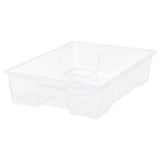
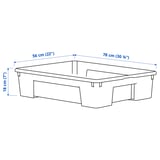
IKEA SAMLA box, 55 L
The big-cat parent's open-box hack — massive floor, easy to wipe clean, easy to replace.
- Size78 × 56 × 18 cm
- In inches30¾" × 22" × 7"
- Price$9.99
- IKEA rating4.6★ (6,914)
Photos: IKEA. Article 001.301.29. Price as listed June 2026.
One honest caveat
That 30¾-inch floor is the win — but the sides are only 18 cm (7 inches). Low walls are perfect for kittens and stiff senior cats stepping in, yet a tall cat that pees standing up can overshoot the edge. For sprayers or standing pee-ers, grab the taller 130 L SAMLA (43 cm sides) instead, or add a clip-on splash guard.
The 60-second box audit
Run through this before you blame the cat. Most accidents trace back to one of these:
- The box is at least 1.5× your cat's body length — measure to be sure.
- It's open, not hooded.
- You have one box per cat, plus one.
- Boxes are spread across rooms/floors, never lined up in a row.
- It's in a quiet spot with two ways out — not beside the food bowl or a loud appliance.
- You scoop daily (twice a day for multiple cats).
- Litter is 2–3 inches deep and a soft, fine texture cats actually like.
- Any sudden change has been cleared by a vet.
The litter that earns a spot in that bigger box
A bigger, open box rewards a litter that clumps hard and has a fine, sand-like texture. These are the Noisy Lion picks cat parents reach for when they size up:

Natural Cassava
Rock-hard clumps and a fine sand-like texture — the match for big open boxes and multi-cat homes.
Shop Cassava →
Green Tea Tofu
Soft, fine, low-dust granules — the texture fussy cats actually accept when you switch boxes.
Shop Green Tea →
12 kg Bulk Bag
A bigger box holds more litter, and big or multi-cat homes burn through it — buy the 12 kg.
Shop 12 kg →Frequently asked
How big should a litter box be for my cat?
At least 1.5× your cat's body length (nose to base of tail) and about as wide as your cat is long. If it only fits the cat standing still, it's too small — there's no room to turn, dig, and cover.
What size box does a Maine Coon or other big cat need?
Large breeds measure 18–20 inches nose to tail base, so aim for 27–30+ inches of interior length. Most store-bought boxes don't reach that — a ~30-inch storage bin like the IKEA SAMLA does, for a fraction of the price.
Covered or uncovered — which is better?
Uncovered, for most cats. Hoods trap odour, cut off escape routes, and cramp big cats. Use a hood only if your cat is genuinely relaxed in it — and switch if you see hovering or fur-shaking at the entrance.
How many litter boxes for two cats?
Three — the n+1 rule (one per cat plus a spare). And place them in three different spots so one cat can't guard them all.
My cat still won't use a big, open, clean box. Now what?
Re-check three things: location stress (noise, traffic, a nearby appliance), the litter texture (most cats prefer soft, fine, low-dust granules), and — if it's a sudden change — a medical cause. When two of those line up, the box usually comes back into use.
A bigger box needs litter that keeps up
A large open box means more surface to scoop and more chances to track. Our plant-based Natural Cassava clumps hard and has a fine sand-like texture — built for big boxes and multi-cat homes. New to plant-based? The Complete Starter Set comes with a pan and scoop to get the setup right.
Shop Cassava litter See the Starter Set


